


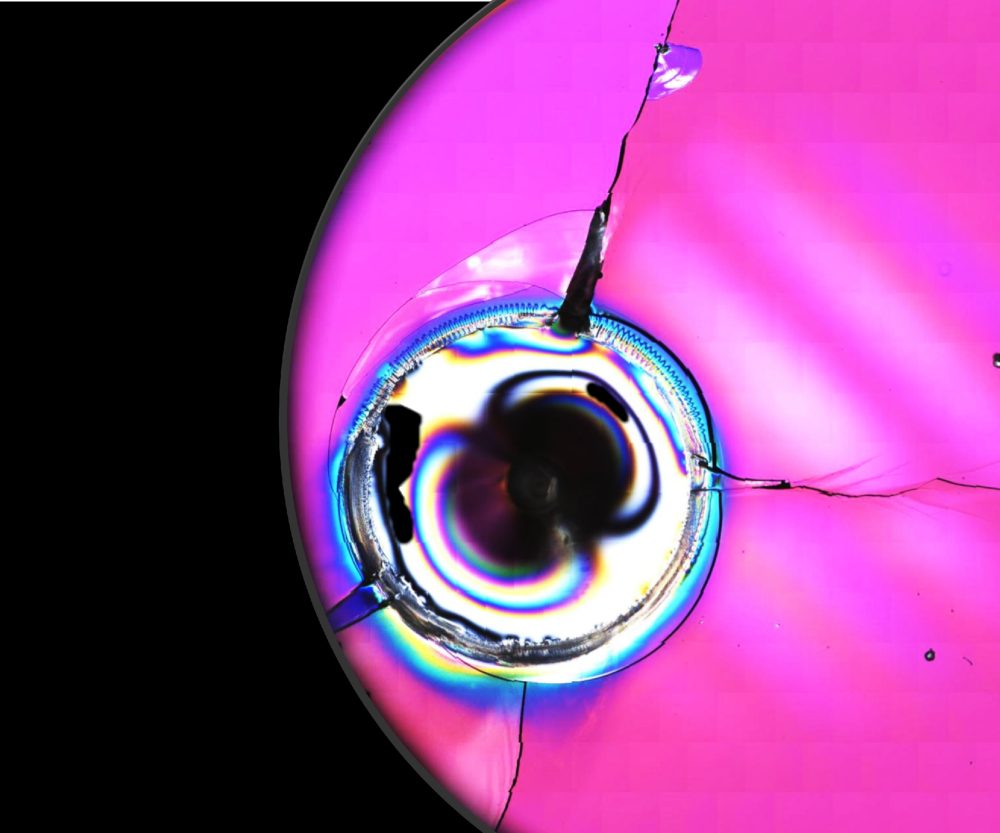
Pass/Fail LIDT Certification Test using Raser Scan Exposure
This technique is designed to separate good and bad optics for critical end-use irradiation conditions are known. The procedure is fast and non-destructive for good optical elements.
Use this test for:
- Checking/certifying laser damage performance of the entire production batch;
- Check purchased optic’s quality before use in critical applications;
- Inspect whether optical element meets qualifications;
- Asses worst case scenario of LIDT of defect-driven damage;
Test description
To perform the Pass/Fail certification test procedure several test sites is often not enough in case of low defect density. In this case a large area is interrogated with a fixed laser irradiation level. In case all test area survives irradiation without damage sample is certified as good enough for further use. Otherwise, the component does not meet the specifications and cannot be used anyway.
Known limitations and risks:
- False-positive results are possible if there is a delayed fatigue effect (use also extended irradiation dose and endurance certification if possible);
- No exact information about the actual LIDT (just lower or higher than irradiation level of certification);
Most popular test parameters for this test
| Wavelength | Pulse duration(1) | Repetition rate | Minimum irradiation level | Interested? |
| 1064 nm | 10 ns | 100 Hz | 90 % of peak | ORDER |
| 532 nm | 5 ns | 100 Hz | 90 % of peak | ORDER |
| 355 nm | 5 ns | 100 Hz | 90 % of peak | ORDER |
| Custom | Check all availability or configure your own at my.lidaris.com | |||
(1) effective pulse duration measured at Full Width Half Maximum
Why certifications are different?
There are various modifications of pass or fail testing. The reason behind such variety is mainly related with dominating failure mode (defect driven or fatigue driven), namely:
- “Classical” certification – covers only small area and short irradiation time, thus often might give false positive outcome for low defect density samples or large optics;
- “Single level raster-scan” certification – covers large test area, but has limited irradiation dose;
- “Endurance certification” – covers small area, but considers long term fatigue or laser-induced ageing effects;
Testing
conditions
Check out all available testing capabilities. Identify your system in our “Available testing conditions” table.
Related tests
Show all-
 Raster scan
LIDT testIt characterizes the worst-case scenario when it comes to large optics and defect-driven damageread more -
 "Classical"
Lifetime TestThis test is available at ps, fs pulse duration and @kHz repetition rates: allows to investigate LIDT, ageing and lifetimeread more -
 ISO S-on-1
LIDT test (21254-1,2)The most popular technique used for laser-induced damage threshold (LIDT) characterization of laser optics.read more -
 R-on-1
LIDT testTesting protocol, which provides preliminary information about the LIDT of the surface-limited samplesread more -
 ISO 1-on-1
LIDT test (21254-1,2)Single-shot technique for determination of “intrinsic” laser-induced damage threshold of coatings.read more

Test bundles and packages
-
more info
kW Class Optics Characterization at IR (1070nm) CW regime
Lorem ipsum dolor sit amet, consectetur adipiscing elit aenean euismod bibendum laoret lorem ipsum dolor. -
more info
Bundle 1
Lorem ipsum dolor sit amet, consectetur adipiscing elit aenean euismod bibendum laoret lorem ipsum dolor. -
more info
Bundle 1
Lorem ipsum dolor sit amet, consectetur adipiscing elit aenean euismod bibendum laoret lorem ipsum dolor. -
more info
Bundle 1
Lorem ipsum dolor sit amet, consectetur adipiscing elit aenean euismod bibendum laoret lorem ipsum dolor.
more tools and useful information
-
open

Testing conditions
Check out all available laser damage testing conditions (wavelengths, pulse regimes, environments, and more). -
open

Laser Damage infobase
Check out a useful glossary of terms and simple explanations related to the main topics of laser damage terminology. -
open

Online Fluence calculator
Check out a calculator equipped with laser-related calculus that is frequently required in practice: such as laser fluence. -
open

Downloads and docs
Here you can download all information about laser damage testing available at Lidaris. -
open

New client guide
Lorem ipsum dolor sit amet, consectetur adipiscing elit aenean euismod bibendum laoret lorem ipsum dolor. -
open

Orders FAQ
Lorem ipsum dolor sit amet, consectetur adipiscing elit aenean euismod bibendum laoret lorem ipsum dolor.

Have any
Questions?
Feel free to let us know if you have any concerns. We can always help you with choosing the right solution for your specific needs.